
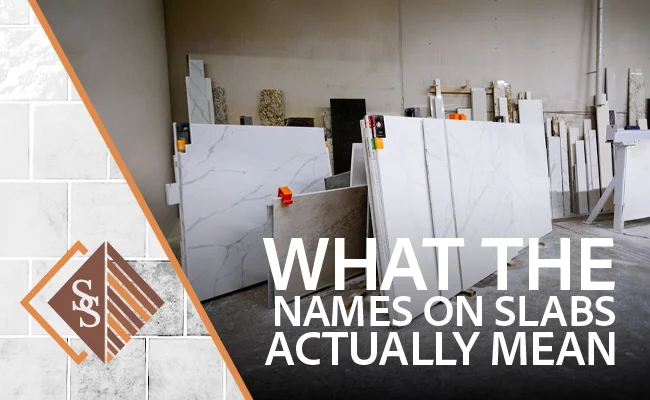
Walk our warehouse and you will see Calacatta on slab after slab, a run of Carrara, and a Taj Mahal collection. None of them were quarried. They are engineered quartz, and the names are borrowed from the natural stones whose look they are made to carry.
That is standard practice across every quartz brand, and there is nothing wrong with it as long as you know what you are buying. So here is what the names refer to, what engineered quartz actually is, and where it behaves differently from the stone it is named after.
Carrara and Calacatta: two marbles from the same mountains
Both names come from the Apuan Alps in northwest Tuscany, where marble has been quarried since Roman times. Carrara is the town at the foot of the mountains, and Carrara marble is the everyday stone of the region: a soft grey-white background with fine, feathery grey veining. It is the most abundant of the Apuan marbles, which is why it has always been the more affordable one.
Calacatta comes from a smaller set of quarries higher in the same range. Its background is a brighter, whiter white, and its veining is the opposite of Carrara’s: bold, thick and distinctly drawn, in greys that can run to taupe, brown and gold. Because those deposits are rarer, Calacatta has always cost more, and the name has come to mean “dramatic white marble” in the way Carrara means “quiet white marble.”
When a quartz slab is called Calacatta, that is the promise: a white field with a few heavy, confident veins. When it is called Carrara, expect softer, busier, greyer movement. Everything after the first word is the manufacturer’s own name for the particular pattern.
Taj Mahal: a quartzite, not a marble
Taj Mahal is the odd one out, because the stone it is named after is not marble at all. Taj Mahal is a natural quartzite quarried in the state of Ceará in northeastern Brazil. Quartzite is a metamorphic rock that began as sandstone and was compressed into something far harder than marble, and Taj Mahal in particular is known in the trade for its very low absorption compared with other quartzites.
Its look is creamy white to warm beige with soft, flowing veins in gold, grey or brown. It became popular precisely because it gives a marble-like warmth in a stone that can take a working kitchen. That is the look quartz manufacturers reach for when they name a slab Taj Mahal: a warmer, calmer white than Calacatta, with veining that drifts rather than strikes.
What engineered quartz is
Engineered quartz was developed in the 1960s by Breton S.p.A. of Treviso, Italy, and most of the world’s quartz is still made on Breton’s method or one derived from it. Crushed quartz, roughly 90 to 93 percent of the slab by weight, is mixed with polyester resin and pigment, cast into a mold on a moving belt, and then compressed under vacuum while being vibrated, which drives the air out and packs the mix into a dense, nonporous slab that is then cured.
The result behaves differently from any of the three stones above in ways that matter in a kitchen.
Hardness. On the Mohs scale, marble sits around 3 and quartz around 7. That is the difference between a stone that scratches with a steel knife and one that does not. Natural Carrara and Calacatta marble etch when lemon juice or vinegar touches them; the quartz slabs that carry their names do not.
Porosity. Marble must be sealed and resealed. Engineered quartz is nonporous, and manufacturers state plainly that it needs no sealing. A red wine spill on a Calacatta quartz is a wipe. On Calacatta marble it can be a stain.
Heat. Here the natural stone wins. The resin in engineered quartz is stable at ordinary kitchen temperatures and is not affected below roughly 150 degrees Celsius, about 300 Fahrenheit, but a pan straight off a burner exceeds that. Every quartz manufacturer tells you to use a trivet. Marble and quartzite tolerate more direct heat.
Sunlight. The resin also yellows under ultraviolet light, which is why engineered quartz is not recommended for outdoor use. Natural stone does not have that limit.
Consistency. No two natural slabs are alike, which is either the charm or the risk of natural stone. Engineered quartz is consistent from slab to slab within a pattern, which makes book matching predictable and lets you plan a large kitchen knowing the second slab will match the first.
Why the names still help
Once you know the vocabulary, the names do useful work. They tell you the family of look before you have crossed the room: Carrara for soft grey movement, Calacatta for bold white and gold, Taj Mahal for warm cream. What they do not tell you is the specific pattern, because every manufacturer draws its own Calacatta.
That is why the slab to judge is the specific one you will buy, not a brand sample. Two slabs both called Calacatta can be quite different, and the only way to choose between them is to stand in front of the actual pieces. Bring your cabinet door and your flooring sample, and look at the whole slab, not a corner. The veining you fall for in a sample may cross your sink cutout on the real thing.
Sources
- Remodelista: The Difference Between Carrara, Calacatta and Statuary Marble
- Sweeten: Carrara vs Calacatta
- Litos: Quartzite Taj Mahal from Brazil (Ceará quarries, low absorption)
- Marble Systems: Is Taj Mahal Granite or Quartzite?
- Wikipedia: Engineered stone (Breton method, composition, Mohs hardness, heat and UV limits)
- MSI: What Is Bretonstone Technology
- Cambria: Product Care (no sealing, trivets)


