
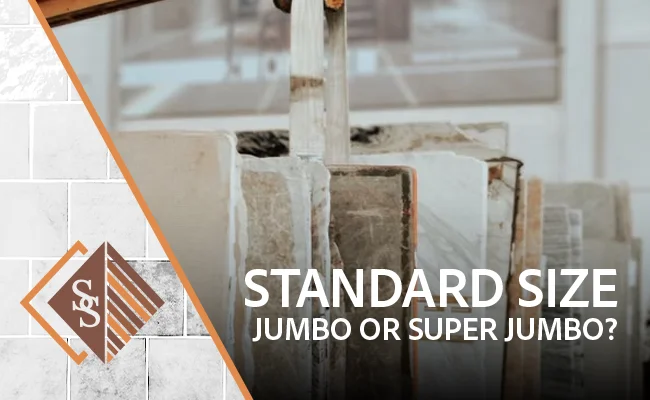
Every quartz countertop starts as a rectangle. The kitchen it goes into almost never is. Somewhere between the slab and the finished counter, a fabricator has to decide where the pieces meet, and that decision is made for them before the saw ever starts. It is made by the size of the slab you buy.
This is the part of a countertop purchase most people never see, so here it is in plain terms: what the three slab sizes actually measure, how far each one reaches, and what that means for the island you have drawn.
The three sizes, measured
Quartz is manufactured, so it comes in set formats. The names are used loosely across the industry, and every brand publishes its own exact dimensions, but the sizes cluster into three groups.
| Format | Typical dimensions | Roughly |
|---|---|---|
| Standard | About 119 by 56 inches | Just under 10 feet by 4 feet 8 inches |
| Jumbo | About 130 by 65 inches. Caesarstone lists its jumbo at 131.5 by 64.5 inches | Just under 11 feet by 5 feet 5 inches |
| Super Jumbo | About 136 to 138 by 78 to 79 inches | Around 11 feet 6 inches by 6 feet 6 inches |
Caesarstone puts the difference between its standard and jumbo formats at roughly 20 percent more surface area per slab. Super Jumbo adds more again, and the width is where it matters most: at 78 inches, a Super Jumbo slab is almost two feet wider than a standard one.
Those are industry figures, not a promise about any one slab. Confirm the exact size of the slab you choose before your fabricator templates. Every slab has a number; ask for it, and for the measured dimensions of that piece rather than the format name.
Why the width decides more than the length
Most kitchen runs are 25 to 26 inches deep, so a standard slab’s 56-inch width is never the problem there. Islands are different. A generous island is 42 to 48 inches deep, and many run wider once seating is added. Once an island is deeper than about 55 inches in either direction, a standard slab cannot cover it in one piece, whatever its length.
Length is the second limit. A standard slab tops out just under 10 feet. An island of 8 feet fits along it. An island of 10 feet does not, so a standard slab forces a seam, and the only questions left are where the seam lands and how well it is hidden.
A guide from the fabrication side lays out the pattern that follows from slab sizes:
- Islands up to about 60 inches: usually no seam.
- 60 to 84 inches: none or one, depending on the slab.
- 84 to 120 inches (7 to 10 feet): one seam, usually unavoidable with a standard slab.
- 120 to 144 inches (10 to 12 feet): one or two.
- Over 144 inches: two or more.
A Super Jumbo slab moves those thresholds. Its 136-plus inch length covers an 11-foot island end to end, and its 78-inch width covers the deepest islands most kitchens have. That is the whole reason the format exists: it takes the seam off the table for the piece of the kitchen everyone looks at.
Where a good fabricator puts a seam
When a seam cannot be avoided, its placement is a craft decision, and there are rules of thumb the trade agrees on.
Running a seam into a sink cutout is a common and sensible technique. The cutout already interrupts the slab, so a seam that ends at the sink is shorter and less visible than one crossing an open expanse. The opposite is true of cutout corners and point loads, which a seam should stay away from.
Every seam also needs cabinet support within about three inches of the joint on each side. A seam that lands over an open span, or over an overhang with no bracket beneath it, is a seam that will move.
Expect a seam to add to the fabrication quote. Standard seams typically run 50 to 200 dollars each, and mitered seams for waterfall ends run 150 to 500 dollars per miter depending on complexity and region.
Waterfalls, book matching and the material they take
A waterfall island runs the countertop down one or both ends to the floor. The top and the leg are cut from the same slab and joined at a 45-degree miter, which is one of the most demanding operations in countertop fabrication. Most fabricators prefer 3 cm material for a waterfall, and the top and the legs must match in thickness or the joint shows.
Book matching goes one step further: two pieces are cut so the veining mirrors at the joint, like the pages of an open book. Engineered quartz makes this more predictable than natural stone because its pattern is consistent across the slab, but it still takes more material. Plan on the layout needing well beyond the countertop’s square footage once the legs and the matching are accounted for, and expect book matching to be the most expensive layout you can choose.
This is another argument for the larger format. A waterfall island with two legs asks for the top and two more panels from the same slab, in the same run of veining. On a standard slab that often means a second slab and a visible change in pattern. On a Super Jumbo slab it can come out of one piece.
Bring the drawing, not just the measurements
The most useful thing you can bring to a slab warehouse is a plan view of the kitchen with the island dimensions, the sink and cooktop positions, and any waterfall ends marked. With that in hand, a fabricator can lay the template over a photograph of the slab and show you exactly where the veining falls and whether a seam is needed at all.
We do not fabricate, and that is by design. Our job is to carry the slab formats and the depth of inventory that make a seamless island possible, and to help you pick the slab in person. Your fabricator’s job is to cut it well. Both go better when the slab is the right size to begin with.
Sources
- Caesarstone: Jumbo Slabs Cover More Ground (jumbo dimensions, 20 percent more surface area)
- UMI Stone: Jumbo Quartz Slab Size (standard and jumbo dimensions)
- Alicante Quartz: Super Jumbo Slab Size (78 by 138 inch format)
- SlabWise: How to Plan Seams on a Large Kitchen Island (seam thresholds, placement, support rule, seam costs)
- Caesarstone: Waterfall Countertops
- MSI: Book Matched Quartz Waterfall Islands


